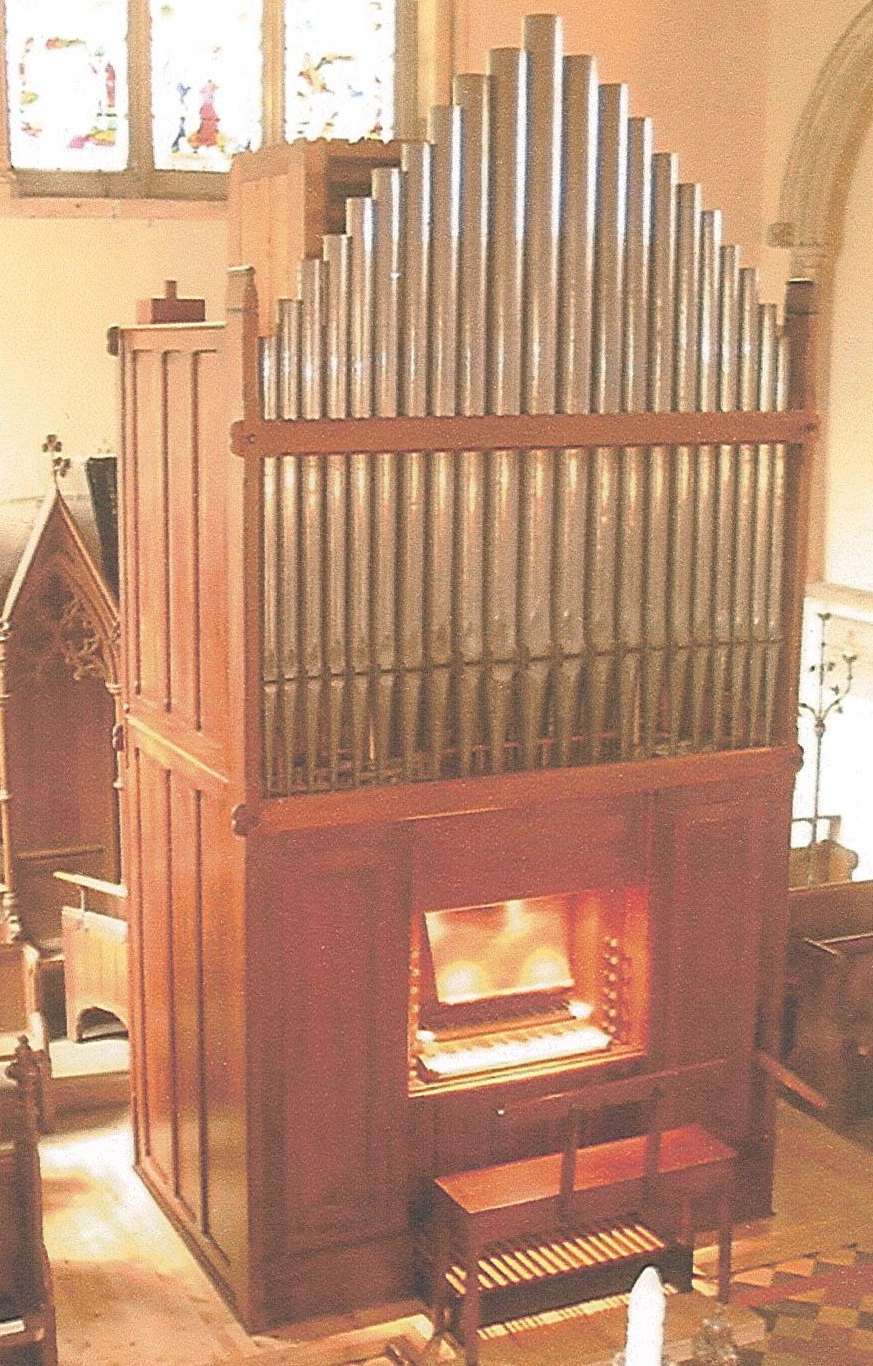
The swell organ compass is from tenor C to f
42 notes whilst the keyboard compass is CC f 54 notes; the bottom
octave of the swell completes the compass just by using the pipes of
the STOPT DIAPASON BASS of the great organ, when drawn.
The
Dia-Octon (common to many Holdich organs) features 12 extra pipes
for each of the 8 & 4ft stops and so provides the octave to every
key on the swell organ making this a remarkably complete and
effective department.
Holdich's original pedalboard had 17
notes with Bourdons for the bottom twelve; the pedalboard was
replaced with the present one of 29 notes by Norman and Beard in
188?
When they completed the pedal bourdon to this compass on
pneumatic action and with Norman & Beard pipes. The present
restoration has replaced the N & B pipes with new made to exactly
follow the style and scale of the Holdich bottom 12 notes; these
latter have been returned to their original sites either side of the
swell box.
In around 1855 Holdich published a leaflet saying
"GM Holdich has great pleasure in announcing that, after
considerable study and labour, he has discovered methods of
Constructing and Voicing Organs, different to those usually made;
the mechanism is more simple, works easily, and is strong in
structure; consequently not so liable to derangement. In voicing the
pipes he has discovered a method of producing a roundness and
richness of tone which sounds grand and majestic, and appears to
traverse every hole and corner of a building, and at the same time
not to oppress the ear. The extra-ordinary effect of this method of
voicing the pipes can only be duly appreciated by hearing two Organs
side by side of the same combination of stops, the one voiced on the
old plan, the other on the new."
The leaflet goes on "G.M.
Holdich also strongly recommends his invention the Diaocton stop,
the merit of which consists in doubling every single stop throughout
the instrument: therefore in a small organ it is invaluable".
The leaflet gives Holdich's address as 4 Judd Place East, New
Road, King's Cross London. In 1858 the premises were apparently
renumbered as 42 Euston Road, King's Cross, London, which is the
address on the Framingham Pigot nameplate. His premises were
acquired by the Midland Railway in 1866 which places the date of
this organ between 1858 and 1866.
As Framingham Pigot church was
completely rebuilt in 1857 it seems likely that the organ was
commissioned soon after then; Holdich lists Framingham in his
"Jubilee" list of churches with Holdich organs which he published in
1887.
The original siting of the organ in the church is a
mystery, there being no other site than the impossible one in which
we found it which was in the room adjacent to the Chancel from which
it could neither be properly heard or seen. Word of mouth has
suggested it was once in the tower gallery but as the organ is the
exact width between the tower walls this seems unlikely as there
would have been no room for the organist to pass it to reach the
console.
On my first inspection of the organ it was obvious
that Norman & Beard had altered the pedal organ and completed the
pedal compass to 29 notes. I found a job number 2280 on the
additional Norman & Beard pipes and wrote to the British Organ
Archive who hold the Norman & Beard records.
Two interesting
entries were found in the N & B order books.
2 May 1891 no 423
Remove organ altering
bellows action making back casing New end framing to be charged to
Mr. Read, Carpenter.
12 Mar 1898 no 2280
To complete
the compass of the Bourdon to 29 notes with all secondary
alterations take out noisy pedal action and bad soundboard and
substitute pneumatic action and new soundboard £40. The 1891 entry does suggest that the organ was squeezed in
somewhere. We found that the blowing handle had been moved from the
front casing, right hand side to the side case where it suited the
position in which we found it. The back casing and (the treble) end
casing were by N & B there being no bass end case as this was
against the wall of the chancel chamber.
Church pews were cut
and the new floor was laid to allow us to restore the organ and
resite it pride of place in the centre of the West End of the
church. To do this we have replaced virtually all of the Norman &
Beard work with parts made much more in keeping with the Holdich
style.
The completion of the 12 Holdich Bourdon pedal pipes
was again made but with pipes exactly copying the style and scale of
the original. The new pedal action is now tracker and run in the
same manner as the original Holdich 12 note action. These 12 pipes
have returned to their original positions either side of the
swellbox and the additional pipes are neatly placed within the
back of the organ.
The only N & B part retained is their straight
and parallel 29 note pedalboard which did reflect the style and
layout of the original 17 note pedalboard. Prior to our work the
pedal coupler was still of only 17 notes despite the 29 note N & B
Bourdon extension and we have completed this copying the Holdich
levers and action. There is still no swell to pedal as Holdich
did not fit one, (the swell organ being of predominantly tenor C
compass).
The organ case has been completed on all sides in
the style of the Holdich panels and has been polished to grace the
surroundings. Our schedule was to copy the original finish but when
our polisher came to examine the parts he could find no trace of it
ever having had a finish! It now has a fine finish appropriate to
the period and to the location of the organ.
We were
fortunate to again be able to restore a Holdich organ that had never
received tuning slides. The organ still retains its original pipe
lengths and cone tuning. Restoration of the pipework included
carefully rounding out the pipes and carefully resetting this
tuning. When we restored the Holdich organ at Frilsham (which dated
from nearer to 1850) a few years ago we were able to carry out a
similar procedure and discover that the organ was definitely tuned
to an unequal temperament and were then able to go on and discover
exactly what that temperament was for the pipes would not allow
anything else without cutting or excessive coning. Here however the
procedure discovered that the original tuning was equal temperament
- such must therefore also tally with Holdich's methods of
constructing and Voicing organs different to those usually made.
The wind pressure as we found it was 2 3/4" wg. All bellows
weight have GMH on them. A few cut ups had been raised and some tips
opened out.
When we reset the organ in the new much more
favourable position the pipework was almost overblowing and
excessively loud. after experimentation I resorted to lowering the
pressure to 2 1/2" wg and the process of restorative refinishing the
organ began to make great sense. I have a sure feeling that when
Holdich originally brought the organ in he was disappointed with its
location and had to increase the pressure to compensate; it
assumably had to be him as all the weights are GMH. If Norman &
Beard did move the organ from the tower to the chancel it was they
who further strengthened the pipework, somewhat erratically, to
attempt the impossible from this position. It has been an honour to
at last find the fine result that Holdich made but which was never
achieved because of the siting of the organ.
The Framingham
Pigot tone colours are lovely, the keraulophon, (that peculiar
precursor of the Gamba where the pipe has a lead slide with a
hole in it) is rich full toned and exquisite. The Clarabella has
real clarity and articulation (all original) and the chorus work is
bright and colourful. Just as I have discovered with other Holdich's
I have discovered afresh that the organ teaches one how to play the
way it wants to be played and that when one observes this the
results are rewarding, beautiful and exhilarating.