Update Required
To play the media you will need to either update your browser to a recent version or update your Flash plugin.
The Evolution of this Historic Organ.
Seventeenth
century. At its heart is a two manual organ great organ, and choir
by communication (borrowing); a style used by Renatus Harris. It
still has the soundboard and much of the pipework from this organ.
The soundboard is of oak and originally had many more pallets than
the 54 now in use. There were originally double sliders, side by
side, to each stop. Where this organ was, or what it looked like we
do not know.
1813. The organ claims to have been built by G P
England in 1813 for St Stephen’s church Norwich from whence it came.
Interesting markings on the soundboard faceboard tell us a
little more.
1836. Christ John late of Grays London put the -
- bellows 1836. (somewhat illegible).
1851. This organ was
cleaned and the action repaired attended by Samuel Street Organ
Builder Norwich Aug 1851.
1870. Removed and fixed in Cawston
Church Jan 20th 1870 by W C Mack of Gt Yarmouth. (this also
inscribed on the inside of the faceboard).
From the evidence
of the organ it would seem that GP England did not build a new
organ, but rather reused an old organ and added to it, also adding
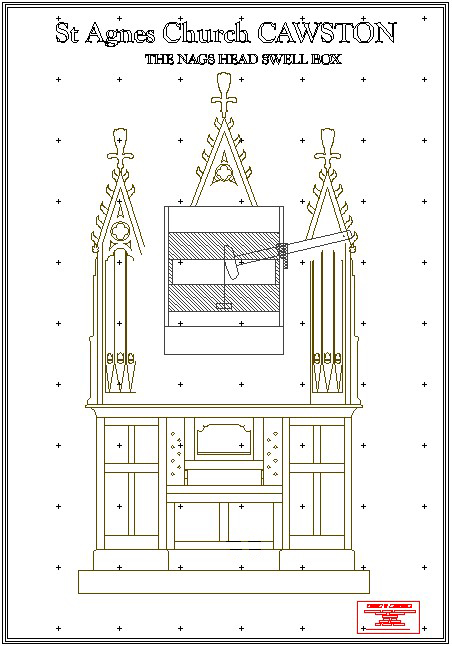
the new swell organ in its “Nag’s Head” swell box. Inside the oak
case is an earlier pine case with more Georgian lines. The swell
organ would have projected out of the back of this case as it now
does again. The pedal section would have likely been a later
addition as is the fine Victorian Gothic Oak casefront. In 1813
organ compass usually commenced at low GG, four notes lower than the
present CC of the keyboards – so this compass is not original and
can only date from around 1850. The inference is that the oak case
and the console with CC compass were fitted at St Stephen’s circa
1850.
1984; Bower & Company restore the great organ only,
soundboard and pipes, and have to disconnect the swell organ and
pedal organ because of lack of funds.
1998; Bower & Company
historically restore and enhance the organ and move it into the Nave
aisle. The enhancement is the making of a full a pedal board of 30
notes of straight and parallel design in keeping with the organ, and
the combining of the 18 old Bourdon pipes with a new stopped bass
which also discreetly and mechanically complete the gamut G the
swell organ with a Stopped bass. Before our work the bottom 18 swell
keys only back coupled to the great. By placing the 10 biggest
Bourdon pipes outside of the original case, we have restored the
early case line with the swellbox projecting above the back case as
it did when England added it.
The historic pipework has all
been reset and it retains its cone tuning. The chorus, apart from
the open diapason dates back to probably pre-Restoration times. The
swell pipework uses many of the pipes once on the old soundboard as
the choir by communication. The Stop Diapason gives the clue that G
P England was involved with the swell organ. The swell stop is the
old choir treble, but as five extra pipes had to be taken he
provided five new metal flutes for the great amongst the wooden
pipework. These are of similar construction to that of his organ in
St George Colegate.
An interesting discovery is that the
swell organ compass extends only to e 53 without any pipes
soundboard or action existing for the top keyboard note f 54. As
this is entirely historical and intervention would be necessary to
add pipes and soundboard space for note 54 we have not done this and
have instead weighted the keyboard top key so that it does go up and
down without sounding.
OBSERVATIONS;
much information has been observed throughout this interesting work.
The organ compass of CC – f 54 has probably been that since Samuel
Street rebuilt the “England” organ in 1854.
The great organ,
though not a major part of the work, was again been looked at. It
definitely was once a soundboard for great organ and choir organ by
communication. It once had a GG compass and two pallets per note
(great & choir) with two slides for several of the stops. Within the
upperboards of these stops are communication chambers complete with
fly valves. The pipework is of the same age as these stops, 100+
years before GP England. Interestingly on the main framework rails
is the site of earlier choir organ trundles marked Ch1 Ch2 and Ch 3.
In its previous to Cawston form with the pipe and conveyance holes
deserted, is an extra note at the bass on the C# side (slider hole,
bar and cavity all there), and the lowest principal pipe is marked
AA and is cut down. (I would suggest that the key compass was then
BB, then CC – e; this with the BB sounding AA).
The great organ stopped diapason is of wood throughout except
for six solidly capped metal pipes with long ears. I have long been
perplexed by this, but upon looking at another GP England organ I
observe that he used this form of metal stopped diapason; in the
swell we find the wood pipes that may once have been on the great,
which had its own treble above middle c, hence the need for extra
pipes for the tenor octave. Before the work I was of the belief that
GP England added the swell organ but at the restoration was
surprised and mystified by the swell pipework. The swell open
diapason has the lowest 4 pipes of 19th cent. construction – the
rest are much older with markings more akin to the great organ
(samples of markings have been recorded).
The casework. I
have always stated that the older pine case is significantly intact
behind the oak front case. The side panels even now are from the
older case. More details were found of part of the shapes of the
older decorations and photos have been taken of some of these
details. I cannot say whether these belong to 1813 or earlier. On
looking at a picture of Winchester organ case by designed by Edward
Bloore in 1830s I see many similarities to the Cawston Façade. Is it
then that the Cawston case façade was designed by Bloore? (It seems
he died in 1879).
The organ has a fascinating history but
much still remains for future unravelling. The present restoration
has preserved everything historical that it can and nothing
significant dating from earlier than the 20th century has been
removed in the present work apart from the bulky 18 note pedal
soundboard and action parts of late 19th century construction.


 OBSERVATIONS;
much information has been observed throughout this interesting work.
The organ compass of CC – f 54 has probably been that since Samuel
Street rebuilt the “England” organ in 1854.
OBSERVATIONS;
much information has been observed throughout this interesting work.
The organ compass of CC – f 54 has probably been that since Samuel
Street rebuilt the “England” organ in 1854.